Design is often described as a universal language, yet anyone who has worked across multiple markets knows this idea can be a bit optimistic. What works in one country may not in another. To give a quick example, imagine a Burger King ad with the headline ‘Get your hands dirty’. In many countries this messaging is playful and bold, but in Japan for example it would fall flat. For Japanese people, cleanliness carries cultural weight and the message would feel uncomfortable rather than inviting. In this case, the same idea that creates appetite in one region creates unease in another. Small details can for sure make the difference between relevance and dissonance.
Brands aspiring to expand internationally need more than good aesthetics. They need design systems that travel well, adapt fast and stay coherent no matter where they land. As creative teams increasingly support global clients, smart design becomes a huge priority.
Design’s role in global expansion
From my experience, when companies enter new markets their biggest challenges are usually different customer expectations, regulations, technological habits and visual cultures can either make or break an otherwise strong brand. Smart design reduces that complexity, as it creates rules that are flexible and ultimately sets boundaries that support creativity instead of restricting it. Most importantly, it gives every team worldwide a shared reference point. The result is a brand that feels local, consistent and confident, all at the same time. To put it simply, smart design supports the two things every expanding brand wants: credibility and growth.
'Design travels well only when it respects where it lands.'
Brands that tried vs nailed it
Real examples make the point clearer than any theory. When Pepsi entered several Asian markets in the 1960s with a global campaign built around the line ‘Come alive’, the translation in some regions was interpreted as ‘Bring your ancestors back from the dead’. It became a textbook example of what happens when a brand pushes a message globally without checking how it lands locally.
On the other side of the spectrum, Netflix has scaled at remarkable speed because it adapts not just language but entire content strategies to fit each region. Their design system stays consistent, yet key visuals, editorial tone and even promotional pacing shift to match local viewing habits. The result is a brand that feels global but behaves locally enough for people to trust it.
Another well known contrast is IKEA compared to Walmart’s attempt to expand into Germany. IKEA succeeds internationally because it adapts details that matter while protecting the core. It changes room layouts to match different home sizes, adjusts naming approaches, and sometimes modifies products based on cultural habits, yet its visual language and store experience stay recognizable. Walmart, by contrast, entered Germany in 1997 with a playbook copied from the US. Policies like enforced employee cheer routines and a smile focused service model clashed with local norms and felt forced rather than welcoming. The brand never recovered its footing and eventually withdrew in 2006. These examples show that global scale does not come from consistency alone, but from consistency supported by context.

Smart design and smarter systems
We are now fully aware that local culture affects everything from preferred color combinations to reading patterns to how customers interpret tone of voice. Smart design acknowledges this early and uses research to inform decision making in order to create a design foundation that behaves like a system. This includes interaction between elements, guidance that is actually practical and visual logic that holds up even when the brand is stretched into new formats or markets.
It’s important to mention though that a strong design system should not try to predict every possible scenario. Instead, it should build a solid foundation and determine key principles. Typography choices that reflect the brand personality, color logic that adapts to cultural norms without losing recognisability, and layouts that can scale from a hero billboard in Manhattan to a mobile ad in Singapore.
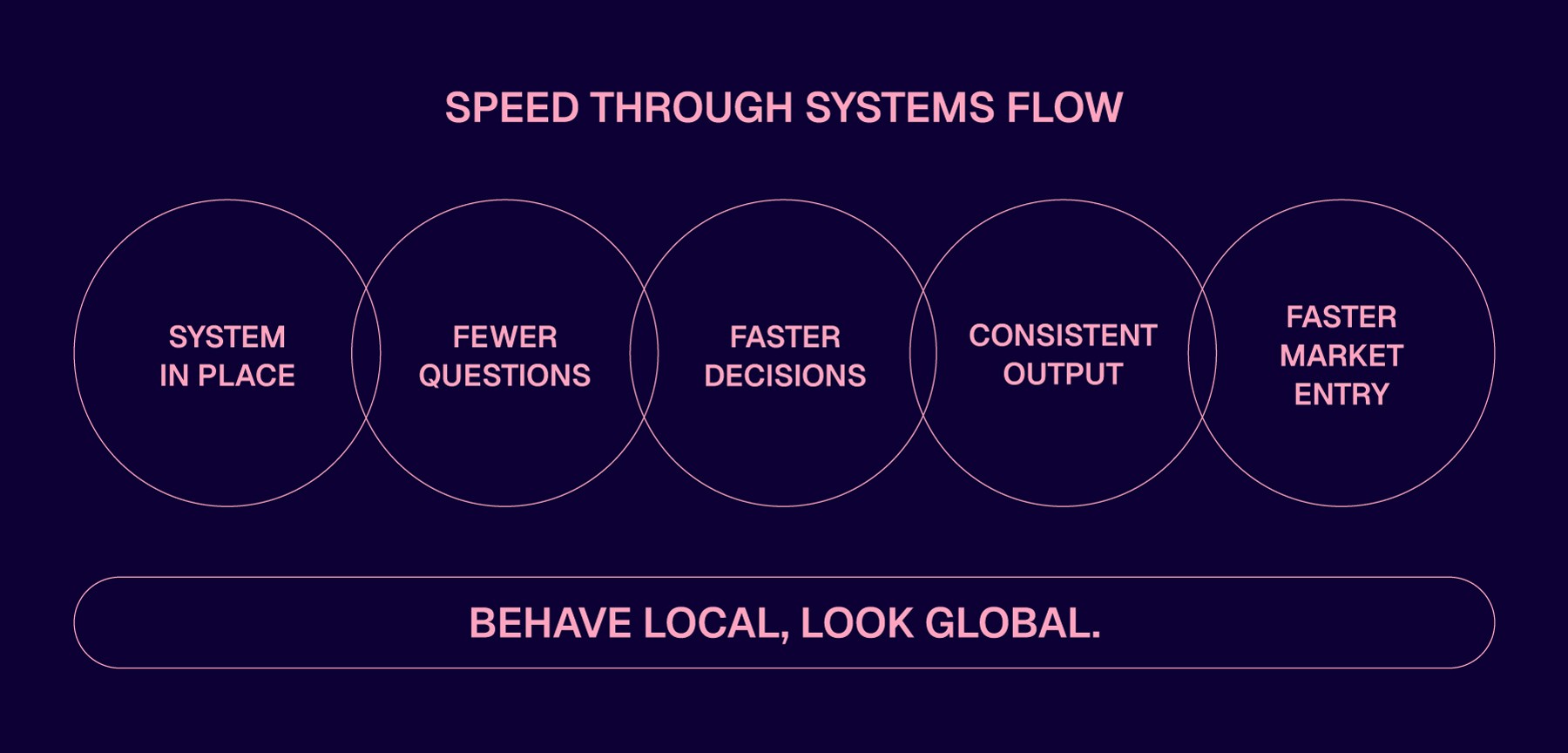
This in turn helps with speed. When design systems are built well, teams make decisions faster since no one has to reinvent the wheel or play guessing games. This efficiency is not the glamorous part of design, but it is often the element that allows a brand to expand without growing pains.
Time zones and talent pools
Another important aspect when it comes to scaling design across borders is not only about the visuals is how teams collaborate. Creative work now happens in distributed networks where designers, strategists and clients exchange ideas across time zones, which means processes matter just as much as pixels.
Clear handoff practices, transparent feedback loops and shared creative tools make the journey smoother for everyone. When teams know how work moves from one continent to another, the brand gains a level of operational harmony that customers will never see, but always feel.
The thing with regulations
Regulations also quietly shape just as much of the design. What counts as acceptable imagery, what disclaimers are required, how data must be handled and even how colors can be used varies widely from market to market. For example, financial brands entering the EU must adapt their layouts to meet strict transparency requirements. Food and beverage brands entering markets like France or South Korea often need extra packaging space for mandatory labels or bilingual instructions. These constraints should be part of the design landscape, and when teams acknowledge regulation as a creative parameter rather than an obstacle, the work becomes stronger.
A future built on flexible creativity
Globalization has not made design easier, but has made it more interesting. Brands now need to communicate across cultures while still sounding like themselves, which means that designers need to think system first and market second. Companies in turn need creative partners who understand that smart design is not about impressing peers, but about enabling international growth.
As borders blur and customer expectations evolve, the brands that win will be the ones that treat design as a living, adaptable ecosystem. An ecosystem guided by clarity, informed by context and executed with just enough personality to stand out, no matter where it goes. If you get that right, design becomes a passport rather than a puzzle.
published on plus972.com
related articles